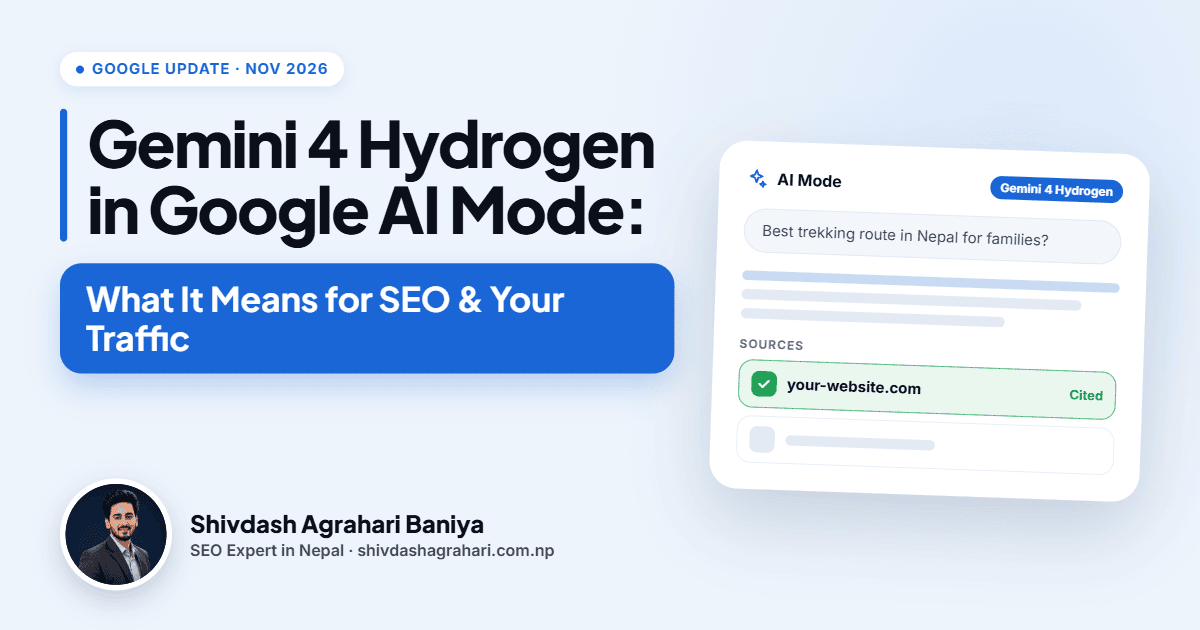
On November 12, 2026, Google quietly made one of the biggest changes to Search this year. A new model, Gemini 4 Hydrogen, became the default brain behind Google AI Mode for every user in the world, free accounts included. It also now answers the hardest questions inside AI Overviews.
If you run a business website, this matters more than any single ranking update. AI Mode decides which websites get mentioned, which get linked, and which get skipped entirely when someone asks a complex question. In this guide I explain what changed, what the data says about traffic, and the exact steps I am taking for my own clients in Nepal and abroad.
Key takeaways
- Gemini 4 Hydrogen is now the default model in Google AI Mode for all users worldwide, starting November 12, 2026. No subscription is needed.
- Two more powerful models, Gemini 4 Argon and Gemini 4 Carbon, are available in AI Mode only to paying Google AI Pro and Ultra subscribers.
- Hydrogen arrived two days into the November 2026 core update, so ranking and citation changes this month have two possible causes.
- AI Mode searches are longer and more conversational, and independent studies show AI answers reduce clicks to websites that are not cited.
- The goal is no longer only to rank. It is to be the source AI Mode cites.
What is Google AI Mode?
AI Mode is the conversational tab inside Google Search. Instead of a list of ten blue links, it gives a written answer built from many websites, with links to its sources, and it lets people ask follow-up questions in the same conversation. It is different from AI Overviews, the short AI summary that appears above normal search results.
AI Mode has grown very fast. According to the first usage report Google shared around Google I/O in May 2026, it passed one billion monthly active users, the average AI Mode search is three times longer than a traditional search, and more than one in six AI Mode searches use voice, images or video.
Gemini 4 Hydrogen, Argon and Carbon: which model is where?
Google released three Gemini 4 models in about one month, which has caused a lot of confusion. Here is the simple version:
| Model | In AI Mode since | Who gets it | What it means for you |
|---|---|---|---|
| Gemini 4 Argon | October 13, 2026 | Google AI Pro and Ultra subscribers (optional) | A small, paying audience |
| Gemini 4 Carbon | November 10, 2026 | Ultra subscribers first, later Pro (optional) | Google’s most capable model, still a small audience |
| Gemini 4 Hydrogen | November 12, 2026 | Everyone, worldwide, by default | This is the model your customers actually see |
One more detail: Google has removed the model name from the AI Mode header, so users no longer see which Gemini model answered them. For website owners, the practical point is simple. Optimize for Hydrogen, because it now shapes the AI answers for almost every searcher.
What changed with Gemini 4 Hydrogen
Google called Hydrogen its biggest model upgrade to Search so far. Based on Google’s announcement and early testing, four changes stand out:
- Better understanding of complex questions. Hydrogen is better at working out what someone really wants from a long, multi-part question, for example “best trekking route in Nepal for a family with kids in April, with a budget hotel near Pokhara”.
- More searches behind each answer. AI Mode runs several related searches at once to build one answer, then suggests links from those searches. Your page can be pulled in for a sub-question even if it does not rank for the main query.
- Richer visual answers. Answers now include more maps, comparison tables and structured layouts. Pages with clear, well-structured facts are easier for the model to turn into these visuals.
- Better answers in more languages. Google says responses are more nuanced across all languages AI Mode supports, including regional phrasing and cultural context.
Will Gemini 4 Hydrogen reduce my website traffic?
The honest answer: if your pages are not cited, probably yes. If they are cited, AI Mode can still send valuable visitors. Here is what the current data shows:
- Fewer clicks per search. SparkToro’s 2026 analysis of Similarweb clickstream data found that from January to April 2026, 68% of US Google searches ended without any click, and only 232 of every 1,000 searches sent a click to the open web.
- AI features reduce clicks to websites. In a preregistered field experiment with 1,100 participants, hiding AI Overviews and AI Mode increased clicks to third-party websites.
- Google says AI still sends traffic. Google’s position is that Search sends billions of clicks every day and its AI features alone send billions of clicks every week.
Both things can be true. Total clicks may hold steady while the share going to any single website falls. The websites that win are the ones AI Mode chooses to cite and link. The visitors who do click through from an AI answer are often further along in their decision, because they have already read a summary and want details, prices or to make contact.
8 steps to stay visible in Google AI Mode
These are the steps I am applying to client websites after the Hydrogen rollout. None of them are tricks. They make your content easier for both people and AI to trust and quote.
1. Answer the full question, not just the keyword
AI Mode searches are long and specific. Build pages that answer the main question and the natural follow-ups: cost, time, comparisons, who it is for, and common mistakes. A page that covers the whole decision is more likely to be used for several parts of one AI answer.
2. Put a clear answer in the first two sentences of each section
Start every important section with a direct, factual answer, then explain. This “answer first” structure is easy for AI to extract and quote correctly, and it helps human readers who skim.
3. Use tables, lists and comparisons where they help
Hydrogen produces more tables and structured answers. Real HTML tables (not images of tables), step lists and side-by-side comparisons give it clean data to work with.
4. Show real experience and original data
AI can summarize generic content from anywhere. It cannot copy your own results. Add your own screenshots, numbers, case studies, photos and lessons learned. In my experience this is the single biggest difference between pages that get cited and pages that get summarized away.
5. Make your authorship and business details obvious
Every article should show who wrote it, their experience and how to contact the business. Keep your name, address and phone number consistent across your website, Google Business Profile, LinkedIn and directories, so AI systems can confidently connect them to one entity.
6. Add accurate structured data
Use schema markup that matches what is visible on the page: Article, Person, Organization or LocalBusiness, Product, FAQ and Review where they genuinely apply. Structured data does not guarantee citations, but it removes guesswork about who you are and what the page covers.
7. Build topic clusters, not single pages
Because AI Mode runs several related searches for one question, a group of connected pages on the same topic (a main guide plus supporting articles, all linked together) gives you more chances to be pulled into the answer.
8. Track AI visibility, not only rankings
Search your own brand and your main services in AI Mode every month and note whether you are mentioned, linked or missing, and which competitors appear instead. Check Google Search Console for changes in impressions versus clicks. A rise in impressions with fewer clicks is often a sign of AI answers at work.
What this means for businesses in Nepal
Nepali businesses face a specific opportunity here. Many local and travel-related questions, such as treks, hotels, schools, honey, handicrafts and services in Kathmandu, still have few strong, well-structured sources online. When AI Mode cannot find a clear, trustworthy local source, it falls back to general or foreign websites.
That gap is your chance. A Kathmandu business with a well-structured website, consistent Google Business Profile, real reviews and helpful content in clear English can become the default source AI Mode cites for its niche, often faster than in crowded markets like the US or UK. If you also serve international customers, as many trekking, export and ecommerce brands in Nepal do, AI Mode visibility can bring buyers from those countries directly to you.
How I check if a site is visible in AI Mode
When I audit a website for AI search, I run a simple test before any technical work:
- List the 10 questions customers ask most before buying.
- Ask each one in Google AI Mode, in the same words a customer would use.
- Record whether the brand is mentioned, linked or missing, and which sources are cited instead.
- Compare the cited pages with the client’s pages to find what is missing: a direct answer, data, a table, reviews or clear authorship.
This shows exactly where the gaps are and which pages to fix first. If you would like me to run this check on your website, book a free SEO review here.
Frequently asked questions
What is Gemini 4 Hydrogen?
Gemini 4 Hydrogen is a Google AI model released on November 12, 2026. It is the default model in Google AI Mode for all users worldwide and also handles the hardest questions in AI Overviews.
Do I need to pay to use Gemini 4 Hydrogen in Google Search?
No. Hydrogen is available in AI Mode for all users without a subscription. The more advanced Gemini 4 Argon and Gemini 4 Carbon models are only available to paying Google AI Pro and Ultra subscribers.
Is Gemini 4 Hydrogen the same as the November 2026 core update?
No. The November 2026 core update is a change to Google’s ranking systems that began rolling out on November 10. Gemini 4 Hydrogen is an AI model upgrade that became the AI Mode default two days later. Both can affect your traffic this month, so review your data carefully before deciding what caused a change.
Is SEO still worth it with Google AI Mode?
Yes. AI Mode builds its answers from web pages that it can find, understand and trust, which is exactly what good SEO creates. What changes is the goal: you now want to rank and also be the source the AI quotes and links.
How can I get my website cited in Google AI Mode?
Give direct answers to real customer questions, structure your content with clear headings, lists and tables, show first-hand experience and original data, make your authorship and business details consistent across the web, and use accurate structured data.
Final thoughts
Gemini 4 Hydrogen makes AI answers the normal Google experience for everyone, not just early adopters. That can feel like a threat, but for businesses willing to publish genuinely useful, well-structured and experience-based content, it is also the best chance in years to jump ahead of bigger competitors. Start with the eight steps above, track your AI visibility monthly, and keep improving the pages that matter most to your customers.
Need help getting your business cited in Google AI Mode? I work with businesses in Nepal, the USA, UK, Australia, Canada and the UAE on SEO, GEO and AEO. Get in touch for a free review.
Sources
- Google: Gemini 4 Hydrogen in Search
- Search Engine Journal: Google makes Gemini 4 Hydrogen the default model in AI Mode
- Google: Gemini 4 Carbon is now available
- Search Engine Roundtable: AI Mode drops Gemini label, Carbon rolls out to Pro
- Search Engine Journal: Google reveals first AI Mode usage numbers
- Search Engine Journal: SparkToro data on clicks to the open web
- Studies on AI search features and publisher referrals