
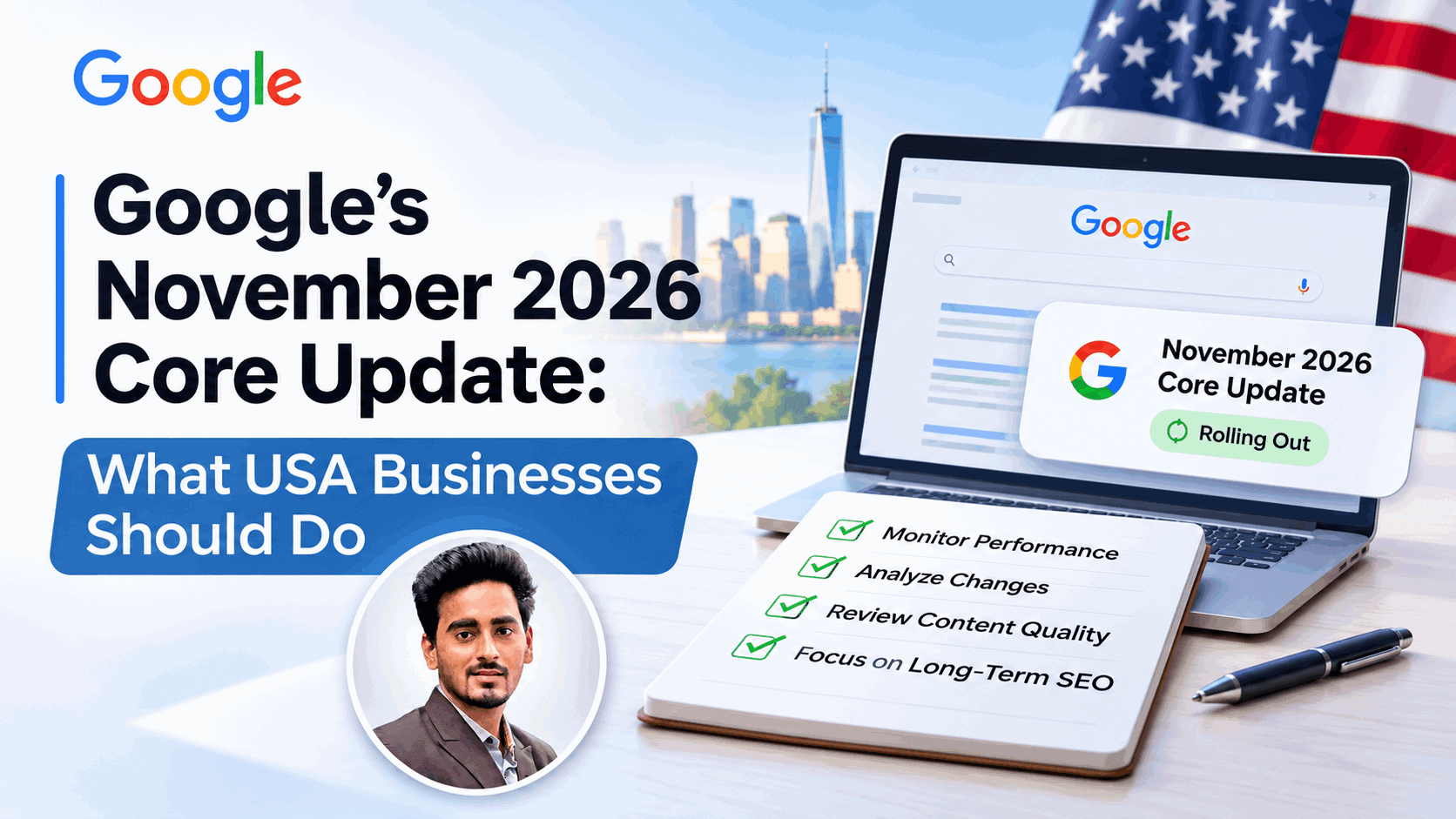
Google’s latest core algorithm update is rolling out just ahead of the busiest shopping season in the United States. Here’s what American businesses need to know, best seo expert in nepal, and what to do if their rankings change.
Google officially began rolling out its November 2026 Core Update on November 10, 2026, introducing broad changes to how websites are evaluated and ranked in Google Search.
The update applies globally, across all languages and industries, and may take up to two weeks to complete.
For businesses across the United States, the timing is particularly important. With Black Friday, Cyber Monday, and the holiday shopping season approaching, even temporary changes in organic search visibility can affect website traffic, customer inquiries, and online sales.
However, a sudden drop in rankings doesn’t necessarily mean your website has been penalized or that your SEO strategy has failed.
Understanding what Google has announced, monitoring the right metrics, and avoiding unnecessary website changes are the best starting points.
What Is Google’s November 2026 Core Update?
Google releases core updates several times a year to improve the overall quality and relevance of its search results.
Unlike updates targeting specific spam practices, core updates involve broader changes to Google’s ranking systems.
According to Google’s official announcement, the November update is intended to improve how relevant and satisfying content is surfaced to searchers across different types of websites.
Key facts about the November 2026 Core Update:
- Release date: November 10, 2026
- Rollout duration: Up to two weeks
- Expected completion: Around November 24, if the rollout takes the full two weeks
- Geographic coverage: Worldwide, including the United States
- Languages affected: All languages
- Update type: Broad core algorithm update
- Current status: Rolling out as of November 12, 2026
This is Google’s third announced core update of 2026, following the March and May updates.
Importantly, Google has not identified specific industries, content formats, or ranking factors targeted by this particular release.
That means claims that the November update specifically targets AI-generated content, affiliate websites, or e-commerce businesses should not be treated as confirmed facts.
Why the November 2026 Core Update Matters for USA Businesses
For American businesses, organic search is more than a source of website visits. It helps customers find products, compare service providers, research purchases, and connect with local companies.
A change in search rankings can affect how easily those customers find your business.
The November update also arrives at a particularly sensitive time for US retailers.
Black Friday falls on November 27, 2026, followed by Cyber Monday on November 30. If the update takes the full two weeks to complete, search rankings could still be settling shortly before these major shopping events.
Consider how different businesses might experience the impact.
E-commerce and Online Retailers
Online stores depend heavily on organic visibility for product pages, category pages, and buying guides.
A ranking decline for commercially valuable queries such as “best running shoes,” “organic skincare products,” or “holiday gifts for men” could reduce traffic during an important sales period.
Conversely, improved rankings could help stores attract new customers without increasing advertising expenditure.
What retailers should do: Monitor the performance of high-value product and category pages while maintaining accurate inventory, pricing, shipping information, and holiday promotions.
Avoid restructuring successful pages based solely on a few days of ranking volatility.
Local Businesses and Service Providers
Businesses such as dental clinics, law firms, HVAC companies, restaurants, and home improvement providers rely on visibility for location-specific searches.
Queries such as “emergency plumber in Dallas” or “family dentist in Chicago” often indicate strong customer intent.
Although the update is not specifically a local-search update, relevant business website pages may experience changes in their organic rankings.
What local businesses should do: Review important service pages, location-specific organic traffic, and lead generation performance.
Continue maintaining accurate business details and genuinely useful local content, but don’t assume every change in Google Maps visibility is caused by the core update.
B2B Companies and Professional Services
B2B businesses frequently rely on educational content, service pages, and industry resources to generate qualified leads.
Their organic visibility may be influenced by how effectively their content answers specific customer questions.
Businesses should review whether their pages provide meaningful expertise, practical examples, original insights, and clear explanations of their services.
Content that merely repeats widely available information may offer less value than resources created from genuine industry experience.
Why Your Google Rankings May Fluctuate During the Rollout
One of the most common reactions to a Google core update is concern over sudden keyword-ranking changes.
A website might lose visibility for certain searches while gaining positions for others.
These movements can occur throughout the rollout, and early changes may not represent the final outcome.
For example, a business may notice that an important service page has dropped from position three to position eight.
That movement alone does not establish whether the page has a quality problem or whether the decline will persist.
Google explains that core updates reassess search results broadly rather than penalizing individual websites.
A page can lose rankings because other pages are being evaluated as more relevant or helpful for particular searches.
The most important rule: Don’t confuse short-term ranking volatility with a confirmed long-term SEO decline.
What USA Businesses Should Do During the November 2026 Core Update
1. Monitor Google Search Console Before Making Changes
Google Search Console should be the starting point for understanding how the update affects your website.
Track these important metrics:
- Organic clicks: Are fewer people visiting your website from Google Search?
- Impressions: Is your website appearing less frequently in search results?
- Average position: Have your important pages or keywords changed ranking positions?
- Click-through rate: Are searchers clicking your listings when they appear?
- Top-performing pages: Which pages are gaining or losing visibility?
For a reliable comparison, save the November 3–9, 2026 performance data as a pre-update baseline.
Google recommends waiting until the rollout is complete and then allowing at least one full additional week before conducting a detailed comparison.
If the rollout finishes around November 24, the first full post-rollout comparison period could be November 25–December 1.
For US retailers, holiday shopping can significantly affect search demand. Compare performance with relevant seasonal and year-over-year data before attributing changes entirely to the algorithm update.
2. Avoid Unnecessary SEO Changes
When rankings decline, businesses may be tempted to rewrite website content, replace title tags, remove pages, or change their internal linking structure immediately.
These decisions can make it difficult to determine whether future ranking changes result from Google’s update or from the website modifications themselves.
During the rollout, avoid:
- Rewriting large sections of your website without supporting evidence.
- Deleting or noindexing content solely because rankings temporarily declined.
- Changing multiple important SEO elements simultaneously.
- Purchasing backlinks or services promising instant algorithm recovery.
- Evaluating your entire website based on a single keyword.
Continue regular website maintenance and necessary technical fixes. The objective is to avoid reactive changes, not to stop improving your website.
3. Review Content Quality and Search Intent
Once the rollout finishes, businesses experiencing sustained ranking declines should examine whether their content genuinely satisfies user needs.
Google’s documentation emphasizes helpful, reliable, people-first content.
For US businesses, that means creating pages that provide information customers can actually use when making decisions.
For example, a home improvement company publishing an article about roof replacement costs should go beyond generic explanations.
A useful resource might include regional cost considerations, factors affecting project estimates, practical examples, and clear explanations of what customers can expect.
Similarly, an e-commerce product page should provide accurate specifications, meaningful product information, authentic imagery, and useful purchasing details.
Ask yourself:
Does this page answer the customer’s question better than the competing search results?
If the answer is no, identify where the content can be improved rather than simply adding more keywords.
4. Strengthen Experience, Expertise, Authoritativeness, and Trustworthiness (E-E-A-T)
Google encourages website owners to consider factors associated with Experience, Expertise, Authoritativeness, and Trustworthiness (E-E-A-T) when evaluating content quality.
E-E-A-T is not a single numerical ranking score or a new feature introduced specifically by the November update.
Instead, it provides a useful framework for evaluating whether content demonstrates real knowledge and credibility.
Businesses can strengthen trust through:
- Clear business and author information.
- Authentic customer experiences and relevant case studies.
- Original photographs, demonstrations, and first-hand insights.
- Accurate information supported by reliable references.
- Transparent policies, contact information, and service details.
For industries involving health, finance, or other important decisions, factual accuracy and appropriate expertise are particularly important.
Adding an author biography or a few trust badges alone will not guarantee better rankings. The underlying content must also provide genuine value.
5. Analyze the Pages That Actually Lost Visibility
Not every ranking decline requires a complete website audit.
Start by identifying the pages and search queries most affected after the rollout.
For example, suppose an online store experiences a 20% decline in organic clicks.
Instead of immediately rewriting the entire website, determine whether the decline comes from product pages, category pages, blog articles, or branded searches.
You may discover that most of the decline comes from a small group of informational articles while important commercial pages remain stable.
That finding would require a very different response from a sitewide decline affecting nearly every page.
Segmenting performance by page type, query, device, country, and search appearance helps businesses make more informed decisions.
6. Protect Holiday Sales Without Relying on Panic SEO Fixes
With Black Friday and Cyber Monday approaching, US retailers should pay particular attention to commercial search performance.
If a key landing page experiences a temporary decline, businesses should assess whether other existing marketing channels can help maintain customer acquisition.
Depending on budget and performance, options may include Google Ads, email marketing, social campaigns, and direct customer engagement.
These channels will not reverse an algorithm update, but they can reduce dependence on organic traffic during a critical sales period.
At the same time, keep holiday offers, product availability, website checkout functionality, and shipping information accurate.
A sudden ranking change should not distract businesses from providing a reliable shopping experience.
How to Measure the Core Update’s Impact Correctly
Businesses should evaluate the update using a consistent measurement framework rather than isolated ranking screenshots.
| Metric | What to investigate |
|---|---|
| Organic clicks | Changes in actual search traffic |
| Impressions | Changes in search visibility |
| Average position | Ranking movements for important queries |
| Organic conversions | Impact on leads, inquiries, and purchases |
| Landing pages | Which URLs gained or lost traffic |
| Non-branded queries | Changes in discovery by new customers |
| Device performance | Differences between mobile and desktop |
Recommended measurement timeline:
November 3–9: Preserve the pre-update baseline.
November 10: Record the official rollout start date.
November 10–24: Monitor trends without drawing premature conclusions.
After confirmed completion: Wait at least one full week before making a detailed comparison.
Following the analysis: Prioritize meaningful improvements where the data demonstrates sustained problems.
The November 24 completion date is an estimate, not a confirmed deadline. Always check Google’s official dashboard for the actual end date.
What If Your Website Loses Rankings After the Update?
A sustained decline can be concerning, especially when organic search generates an important share of business revenue.
However, recovery should begin with diagnosis rather than assumptions.
First, determine the extent of the decline.
A small movement from position two to position four does not necessarily justify substantial content changes.
A larger decline, particularly across multiple important pages, may warrant a deeper assessment.
Review whether affected pages fully answer user questions, provide original value, and meet the expectations of their intended audience.
Also investigate technical problems such as incorrect canonical tags, accidental noindex directives, indexing errors, and website changes made around the same time.
Technical SEO issues are not necessarily caused by a core update, but they can create similar performance symptoms.
If meaningful improvements are needed, prioritize quality over quantity.
Google cautions that recovery is not always immediate. Some improvements may be recognized within days, while broader reassessments can take several months.
There is no guaranteed shortcut or fixed recovery timeline.
What If Your Rankings Improve?
Core updates do not only create losses. Some websites may gain visibility as Google’s systems reassess which results best satisfy searchers.
If your business experiences an increase in organic traffic, investigate which pages benefited.
Look at the queries driving the improvements and determine whether the increased visibility is bringing relevant visitors, leads, or purchases.
Protect successful pages by maintaining accurate content, useful information, and a consistent user experience.
Avoid unnecessary changes simply because a page is performing better.
Use those improvements to understand which types of content are proving most valuable to your audience, without assuming every gain will be permanent.
A Practical SEO Action Plan for US Businesses
Rather than making immediate changes, businesses can approach the November update in three stages.
Stage 1: During the Rollout
Monitor Search Console, preserve performance data, document major website changes, and maintain normal operations.
Pay particular attention to business-critical pages, but avoid treating temporary fluctuations as confirmed losses.
Stage 2: One Week After Completion
Compare performance with the pre-update baseline, identify meaningful changes, and separate algorithm-related movements from seasonal demand and other traffic influences.
Review rankings alongside leads, sales, and conversions.
Stage 3: Following the Performance Review
For pages experiencing substantial, sustained declines, assess content quality, search intent, credibility, and technical accessibility.
Prioritize improvements that make the website more useful to real customers.
Continue measuring results over the following weeks and months.
Final Thoughts: Focus on Long-Term SEO, Not Short-Term Fluctuations
Google’s November 2026 Core Update is another reminder that search visibility cannot be built around algorithm predictions alone.
For businesses in the United States, the immediate priority should be understanding performance changes without disrupting strategies that are already working.
The rollout’s proximity to Black Friday and Cyber Monday makes accurate measurement especially important for e-commerce brands.
Businesses that consistently provide relevant information, demonstrate genuine expertise, maintain technically accessible websites, and deliver useful customer experiences are building a stronger foundation for long-term organic visibility.
Instead of asking how to beat Google’s latest update, businesses should focus on a more practical question:
How can we make our website more useful, trustworthy, and relevant to the customers we’re trying to reach?
That is a more sustainable direction for SEO, regardless of how individual algorithms evolve.
Frequently Asked Questions
When did Google’s November 2026 Core Update start?
Google officially began rolling out the update on November 10, 2026, at 10:06 a.m. Pacific Standard Time.
How long will the November 2026 Core Update take?
Google estimates that the rollout may take up to two weeks. The actual completion date should be confirmed through its Search Status Dashboard.
Does the November update affect USA websites?
Yes. The update applies globally and across all languages, including English-language websites serving customers in the United States.
Should businesses immediately change their SEO strategies?
No. Google recommends waiting until the rollout is complete and allowing at least one additional week before conducting a detailed performance analysis.
Can websites recover after a Google core update?
Yes, rankings may improve over time, particularly where meaningful content or website improvements are made. However, recovery is not guaranteed and can take several months.
Does the update specifically target AI-generated content?
Google has not announced that the November 2026 Core Update specifically targets AI-generated content. Its broader guidance focuses on helpful, reliable, people-first content.
Will the November update affect Black Friday sales?
It could influence organic visibility for some retailers during the holiday shopping period. However, its actual impact on individual businesses will depend on their rankings, search demand, customer behavior, and other factors.